

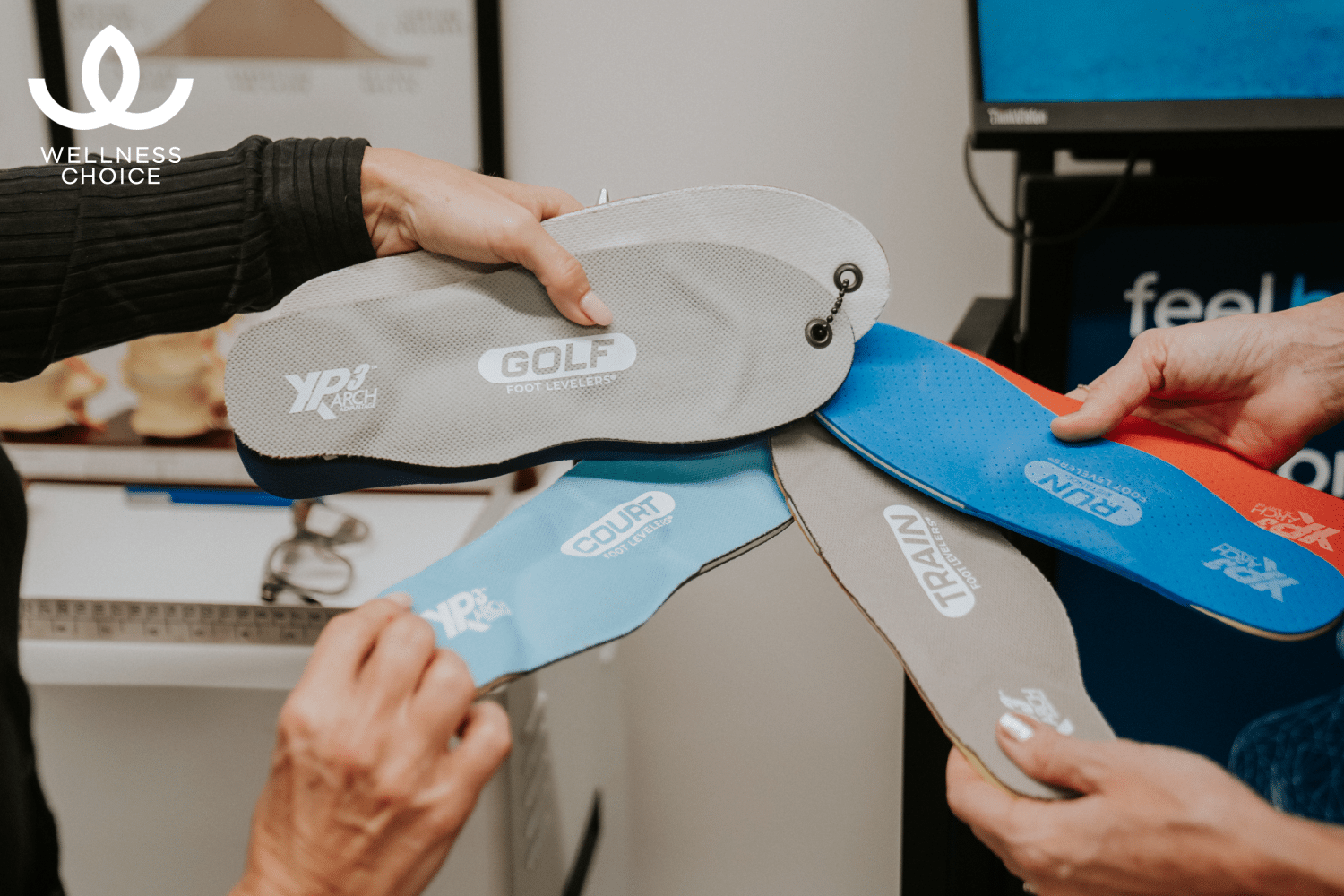
Foot Levelers Custom Orthotics in Costa Mesa
Wellness Choice provides digital foot scanning and custom Foot Levelers orthotics in Costa Mesa, California, serving patients throughout Orange County. Our approach considers foot support, stability, posture, and individual biomechanical needs.
Your feet form the foundation of standing posture and movement. How they support and transfer weight may influence the mechanical demands placed on the ankles, knees, hips, pelvis, and spine.
At Wellness Choice, Dr. Lisa Parissi, DC, owner and chiropractor, evaluates digital foot-scanning results alongside posture, movement, symptoms, footwear, physical demands, and personal goals to determine whether individualized orthotic support may be appropriate.
Explore Custom Orthotics in Costa Mesa
Custom Foot Levelers Orthotics at Wellness Choice
Wellness Choice provides digital foot scanning and custom Foot Levelers orthotics at our Costa Mesa chiropractic office. Custom orthotics are created from measurements of the individual feet rather than selected according to shoe size alone.
Our goal is to determine whether foot mechanics are a meaningful part of a patient's symptoms, movement patterns, stability, or functional needs. Orthotics may be recommended independently or as one component of a broader corrective chiropractic care plan.
Why Your Feet Matter
Each foot contains 26 bones, 33 joints, and an interconnected system of muscles, ligaments, and connective tissues. The feet must provide both mobility and stability as they adapt to the ground, absorb and transfer force, support body weight, and help propel the body forward.
When foot mechanics are altered, the body may compensate farther up the kinetic chain. Excessive or poorly controlled pronation, for example, may be accompanied by changes in lower-leg rotation, knee mechanics, hip movement, or pelvic positioning.
This does not mean that every spinal, hip, or knee problem begins in the feet. Pain and postural changes have many possible contributing factors. Foot findings become clinically meaningful when they correspond with symptoms, movement, footwear, activity, or examination findings.
What Are Custom Functional Orthotics?
Custom functional orthotics are supportive devices made from measurements of an individual patient's feet and designed to fit inside appropriate footwear.
Depending on the patient's needs, they may help:
- Support the foot's arches
- Improve weight distribution
- Increase stability during standing and walking
- Reduce excessive or poorly controlled foot motion
- Improve comfort during daily activities
- Support more efficient lower-extremity mechanics
- Reduce mechanical stress during certain repetitive activities
Supporting the Three Functional Arches
Foot Levelers orthotics are designed to support the three functional arches of the foot:
- Medial longitudinal arch: Along the inside of the foot.
- Lateral longitudinal arch: Along the outside of the foot.
- Transverse or metatarsal arch: Across the forefoot.
Orthotic design depends on the patient's scan, footwear, activity level, symptoms, and functional needs.
Custom Orthotics Versus Store-Bought Insoles
Store-bought insoles may provide useful cushioning or support for some people. Custom orthotics are designed around measurements and individual requirements rather than a standardized foot shape.
| Store-Bought Insoles | Foot Levelers Custom Orthotics |
|---|---|
| Selected primarily by shoe size | Created from measurements of the individual feet |
| Standardized shape and support | Customized to the patient's foot characteristics |
| Often focused primarily on cushioning | Designed for individualized functional support and stability |
| General support design | Accounts for differences between the left and right feet |
| Limited footwear customization | Designs suited to different shoes and activities |
| No professional assessment required | Selected following scanning and professional evaluation |
More customization does not guarantee a better outcome for every person. The orthotic must be appropriate for the individual and compatible with suitable footwear.
Digital Foot Scanning in Costa Mesa
Wellness Choice uses digital foot-scanning technology to evaluate how each foot contacts and distributes pressure through the scanning surface.
The scan may provide information about:
- Relative pressure distribution
- Arch presentation
- Left-to-right differences and asymmetry
- Pronation or supination patterns
- Weight-bearing tendencies
- Foot stability
- Areas of increased or reduced contact
Depending on the scanning system and report, results may include a Pronation/Stability Index, visual foot assessment, and body-assessment illustration.
A digital foot scan is not an X-ray, MRI, or stand-alone medical diagnosis. It does not directly reveal bones, ligaments, tendons, nerves, or every aspect of walking mechanics. Dr. Parissi interprets the results together with relevant health history and clinical findings.
Understanding Pronation and Supination
Pronation
Pronation is a normal movement that allows the foot to adapt to the ground and absorb force. The concern is not pronation itself, but whether it is excessive, poorly controlled, asymmetrical, or clinically related to symptoms and movement patterns.
Supination
Supination helps the foot become more rigid during push-off. Excessive or persistent supination may reduce the foot's ability to adapt and distribute force.
Neither flat feet nor high arches automatically mean orthotics are necessary. Foot shape, movement, symptoms, footwear, and activity must be considered together.
Conditions Evaluated During an Orthotics Assessment
Custom orthotics may be considered when an examination identifies foot mechanics that are relevant to a patient's symptoms or functional needs.
- Plantar heel or arch discomfort
- Plantar fasciitis
- Foot fatigue during prolonged standing
- Uneven shoe wear
- Excessive or poorly controlled pronation
- Supination or high-arch mechanics
- Recurrent ankle instability
- Certain forms of knee discomfort
- Hip or pelvic mechanical stress
- Leg-length or weight-distribution asymmetry
- Discomfort during work, walking, running, golf, or exercise
These conditions do not all originate in the feet, and orthotics are not appropriate for every patient. A clinical evaluation helps determine whether foot mechanics are relevant to the individual situation.
The Feet, Pelvis, and Spine
The body functions as an interconnected kinetic chain. Changes in foot position can influence lower-leg rotation, knee tracking, hip movement, and how forces reach the pelvis and spine.
However, pronation does not automatically cause pelvic tilt, shoulder imbalance, back pain, or neck pain. These relationships are influenced by many factors, and the body can often adapt successfully.
At Wellness Choice, orthotics may be considered when foot findings correspond with measurable postural or movement patterns. They are not used as a universal explanation for every spinal symptom.
For patients participating in corrective chiropractic care, evaluating a significant weight-bearing or foot-stability issue may help identify another mechanical factor worth addressing.
What Makes Foot Levelers Orthotics Different?
Foot Levelers custom orthotics are manufactured from individual foot measurements, with designs selected according to the patient's intended use.
Depending on individual needs, designs may be available for:
- Athletic shoes
- Walking and everyday footwear
- Work shoes
- Golf shoes
- Dress shoes
- Boots
- Lower-profile footwear
Available materials, cushioning, and functional designs allow recommendations to consider comfort, body weight, footwear, activity, and clinical goals. The orthotic must fit the shoes a patient actually wears.
What to Expect From Custom Orthotics
Step 1: Health and Activity Review
We discuss symptoms, footwear, work demands, exercise, previous injuries, and the activities in which greater comfort or stability is desired.
Step 2: Digital Foot Scan
You stand or walk across the scanning system as directed. The scan records foot contact, pressure distribution, arch presentation, and asymmetry.
Step 3: Clinical Interpretation
Dr. Lisa Parissi reviews the scan alongside relevant postural, spinal, movement, and clinical findings.
Step 4: Orthotic Selection
When custom orthotics are appropriate, the style and features are selected according to the scan, footwear, activity level, and clinical needs.
Step 5: Fitting and Adaptation
Once the orthotics arrive, their fit is checked and instructions are provided for beginning use. Wear time may be increased gradually according to comfort and clinical guidance.
Step 6: Follow-Up
Persistent discomfort, incorrect fit, or footwear compatibility problems should be reassessed. Recommendations can be reviewed according to the patient's experience and clinical needs.
Orthotics as Part of Corrective Chiropractic Care
Custom orthotics may be recommended independently or as part of a broader corrective chiropractic plan when foot findings are clinically relevant.
Depending on individual findings, care may also include:
- Chiropractic BioPhysics® corrective methods
- Chiropractic adjustments
- Customized spinal traction
- Posture-specific rehabilitation
- Therapeutic exercise
- Non-surgical spinal decompression
- Movement and footwear recommendations
- Home-care strategies
- Periodic objective reassessment
Orthotics do not adjust the spine, strengthen muscles, or replace rehabilitation. Their purpose is to provide individualized support when examination findings indicate that support may be beneficial.
Custom Orthotics and Spinal Longevity
Wellness Choice emphasizes Spinal Longevity: supporting spinal alignment, movement, and function throughout life.
The feet are where the body meets the ground. More stable and efficient weight-bearing may be one useful component of supporting mobility, physical performance, and long-term function.
For some patients, foot mechanics are an important part of the overall clinical picture. For others, they are not the primary concern.
Our approach is to measure first, determine what is clinically relevant, and recommend orthotics when they make sense for the individual.
Related Chiropractic Services in Costa Mesa
Patients receiving custom orthotics at Wellness Choice may also benefit from evaluation of related postural, spinal, or musculoskeletal concerns.
- Posture Correction in Costa Mesa
- Back Pain Treatment in Costa Mesa
- Neck Pain Treatment in Costa Mesa
- Sciatica Treatment in Costa Mesa
- Scoliosis Correction in Costa Mesa
Custom Orthotics in Costa Mesa and Orange County
Wellness Choice provides digital foot scanning and Foot Levelers custom orthotics at our Costa Mesa chiropractic office, serving patients throughout Orange County, California.
Costa Mesa, California
Orange County, California
Costa Mesa Service Area Information
Wellness Choice provides custom orthotics assessments at 150 Paularino Ave Ste D190, Costa Mesa, CA 92626. We serve patients throughout Costa Mesa and Orange County. Additional local information and driving directions are available for Costa Mesa 92626 and Costa Mesa 92627.
Serving Costa Mesa and Orange County
Our Costa Mesa chiropractic office serves local patients and people traveling from communities throughout Orange County, including Irvine, Huntington Beach, Newport Beach, Newport Coast, Corona del Mar, and surrounding areas. All custom orthotics assessments take place at our Costa Mesa office.
Frequently Asked Questions About Custom Orthotics
What's the difference between custom orthotics and store-bought insoles?
Store-bought insoles typically provide general cushioning or arch support using standard sizes. Custom functional orthotics are made using measurements of your individual feet and may be designed to address specific concerns involving foot stability, pressure distribution, and movement mechanics. At Wellness Choice, we use Foot Levelers technology to help determine whether custom orthotics are appropriate for your needs.
How does the Foot Levelers digital foot scan work?
The Foot Levelers digital scanning system captures information about your feet, including arch presentation, weight distribution, and potential asymmetries. Dr. Lisa Parissi reviews the scan alongside your health history, symptoms, and clinical findings. A foot scan does not independently diagnose the cause of pain, but it can provide useful information when evaluating your foot mechanics and orthotic needs.
Can custom orthotics help with foot, knee, hip, or back pain?
Custom orthotics may help selected patients when foot mechanics contribute to discomfort, instability, or altered movement patterns. They may be considered as part of conservative care for conditions such as plantar fasciitis or certain foot-related alignment concerns. However, knee, hip, and back pain can have many causes, and orthotics are not a guaranteed solution. An individualized evaluation helps determine whether they may be beneficial.
How long does it take to adjust to custom orthotics?
The adjustment period varies depending on your foot structure, activity level, footwear, and orthotic design. Many patients begin wearing their new orthotics for shorter periods and gradually increase use as tolerated. Some initial awareness is normal, but significant or persistent discomfort should be reported so the fit and recommended wear schedule can be reviewed.
Where can I get Foot Levelers custom orthotics in Costa Mesa?
Wellness Choice offers Foot Levelers digital foot scanning and custom orthotic evaluations at our chiropractic office located at 150 Paularino Ave Ste D190, Costa Mesa, CA 92626. Dr. Lisa Parissi evaluates each patient's individual needs to help determine whether custom functional orthotics are appropriate. We serve patients from Costa Mesa and throughout Orange County. Call (949) 387-1333 to learn more or schedule an appointment.
Schedule a digital foot scan at Wellness Choice to learn whether individualized orthotic support may be appropriate for your needs.
Schedule an Assessment or Call (949) 387-1333Custom orthotics are not appropriate for every condition, and individual results vary. A digital foot scan does not replace medical imaging or a comprehensive clinical evaluation.
$149
New Patient Special
Full Orthopedic and Neurological Exam, Digital Posture Analysis, MLS Laser treatment, X-Rays, and Doctors report of findings. A $600 Value.
Our Location
Wellness Choice
150 Paularino Ave Ste D190
Costa Mesa, CA 92626
Phone: (949) 387-1333
Conveniently located in Costa Mesa, serving patients throughout Orange County.